- Your cart is empty
- Continue Shopping
Free Shipping for orders over $150
Welcome to Tittan Peptides!
Free Shipping for orders over $150
Welcome to Tittan Peptides!

$45.00
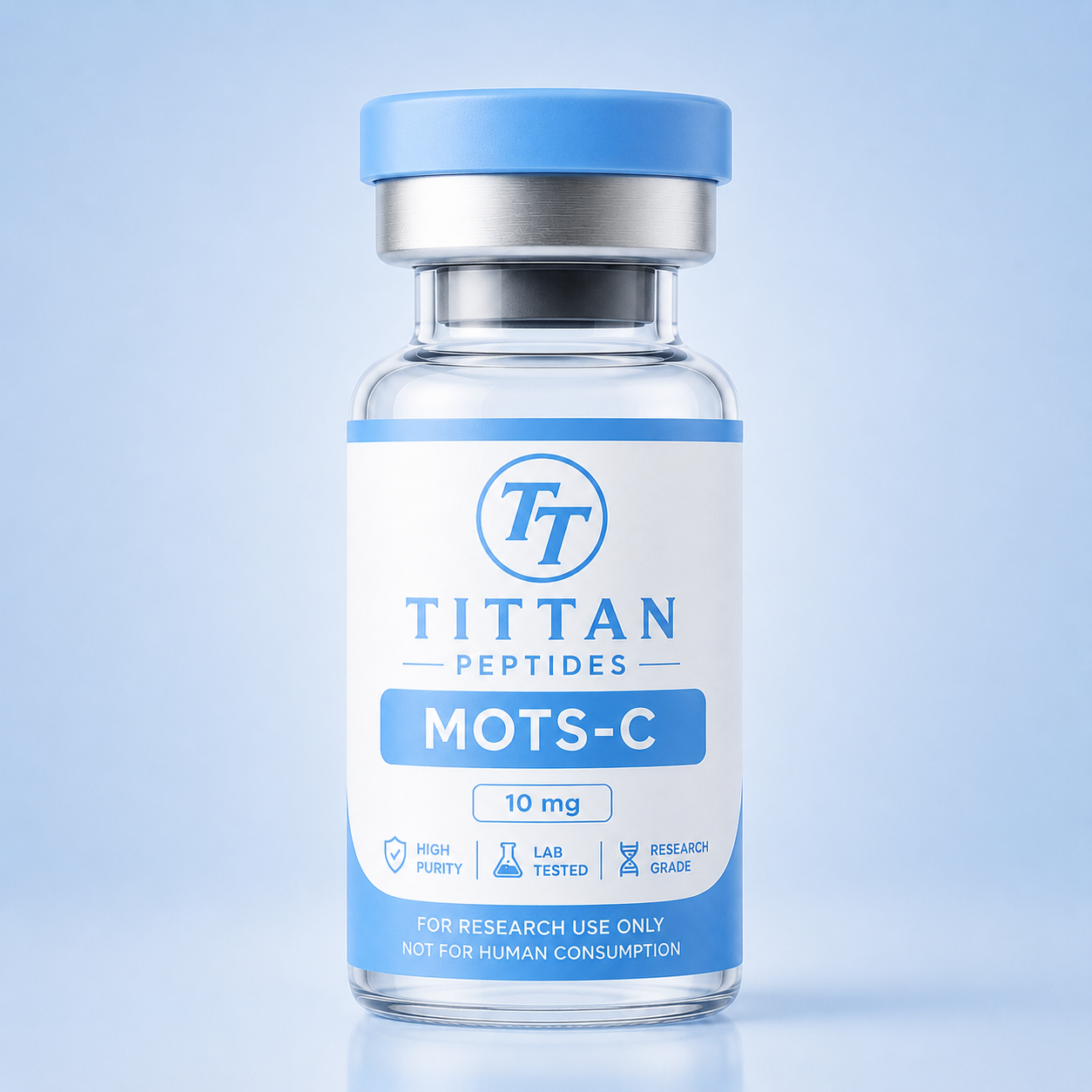
MOTS-C is a 16-amino-acid mitochondrial-derived peptide (MDP) encoded within the mitochondrial 12S rRNA gene. Unlike nuclear-encoded peptides, MOTS-C is translated directly from mitochondrial DNA. Therefore, it serves as a unique research tool for studying mitochondrial–nuclear communication, metabolic regulation, and cellular stress responses.
This synthetic lyophilized peptide is manufactured to ≥99% purity and verified by independent HPLC and mass spectrometry. In addition, MOTS-C functions as a hormone-like signaling molecule that regulates metabolic homeostasis through AMPK activation and folate metabolism modulation. Preclinical research shows its role in improving insulin sensitivity, reducing adiposity, and supporting mitochondrial biogenesis. Each vial is intended exclusively for in vitro and preclinical laboratory applications.
Ultra-High Purity: ≥99% confirmed by third-party HPLC analysis
Mitochondrial-Encoded Sequence: Unique 16-amino-acid peptide (MRWQEMGYIFYPRKLR)
AMPK Activator: Modulates metabolic pathways independent of growth hormone signaling
Stable Lyophilized Format: Allows easy reconstitution for cell culture or preclinical research
Research Use Only: Not for human consumption, therapeutic use, or clinical application
Specification | Detail
Molecular Formula | C₁₀₁H₁₅₂N₂₈O₂₈
Molecular Weight | 2,174.47 g/mol
Sequence | Met-Arg-Trp-Gln-Glu-Met-Gly-Tyr-Ile-Phe-Tyr-Pro-Arg-Lys-Leu-Arg
Purity | ≥99% (HPLC)
Appearance | White lyophilized powder
Storage (Lyophilized) | -20°C, protected from light and moisture
Storage (Reconstituted) | 2–8°C for up to 7 days; aliquot for longer storage
Metabolic Homeostasis: AMPK activation, glucose uptake, and insulin sensitivity in skeletal muscle and liver models
Obesity & Adiposity: Thermogenesis, browning of white adipose tissue, and lipid metabolism
Aging & Longevity: Mitochondrial dysfunction, oxidative stress, and cellular senescence
Exercise Mimicry: Metabolic adaptations without physical activity
Bone Metabolism: Osteoblast differentiation and bone density regulation
Parameter | Recommendation
Reconstitution | Sterile water or PBS (pH 7.0–7.4)
In Vitro Concentration | 1–50 µM (muscle, hepatocyte, or adipocyte cultures)
Preclinical Dosage (Rodent) | 5–15 mg/kg, intraperitoneal (daily or every other day)
Duration of Effect (In Vivo) | 60–90 minutes post-administration
Note: These values are for laboratory protocol design only and not for medical dosing.
MOTS-C exerts its research-documented effects through several pathways. In particular, it activates AMPK in skeletal muscle and liver, which improves glucose utilization. In addition, it modulates the folate cycle by inhibiting methionyl-tRNA synthetase (MARS), thereby altering one-carbon metabolism.
Furthermore, it promotes mitochondrial biogenesis by upregulating PGC-1α, NRF1, and TFAM expression. It also enhances insulin sensitivity by reducing hepatic gluconeogenesis and increasing peripheral glucose uptake. Finally, it reduces inflammation by suppressing NLRP3 inflammasome activation.
Feature | MOTS-C | Humanin | MOTS-c (Alternative Name)
Origin | Mitochondrial 12S rRNA | Mitochondrial 16S rRNA | Same as MOTS-C
Amino Acids | 16 | 24 | 16
Primary Mechanism | AMPK activation | Neuroprotection | AMPK activation
Research Focus | Metabolism, insulin sensitivity | Neurodegeneration, cytoprotection | Metabolism
Nuclear/Mitochondrial Signaling | Mitochondria-to-nucleus | Mitochondria-to-nucleus | Mitochondria-to-nucleus





Reviews
There are no reviews yet.