- Your cart is empty
- Continue Shopping
Free Shipping for orders over $150
Welcome to Tittan Peptides!
Free Shipping for orders over $150
Welcome to Tittan Peptides!

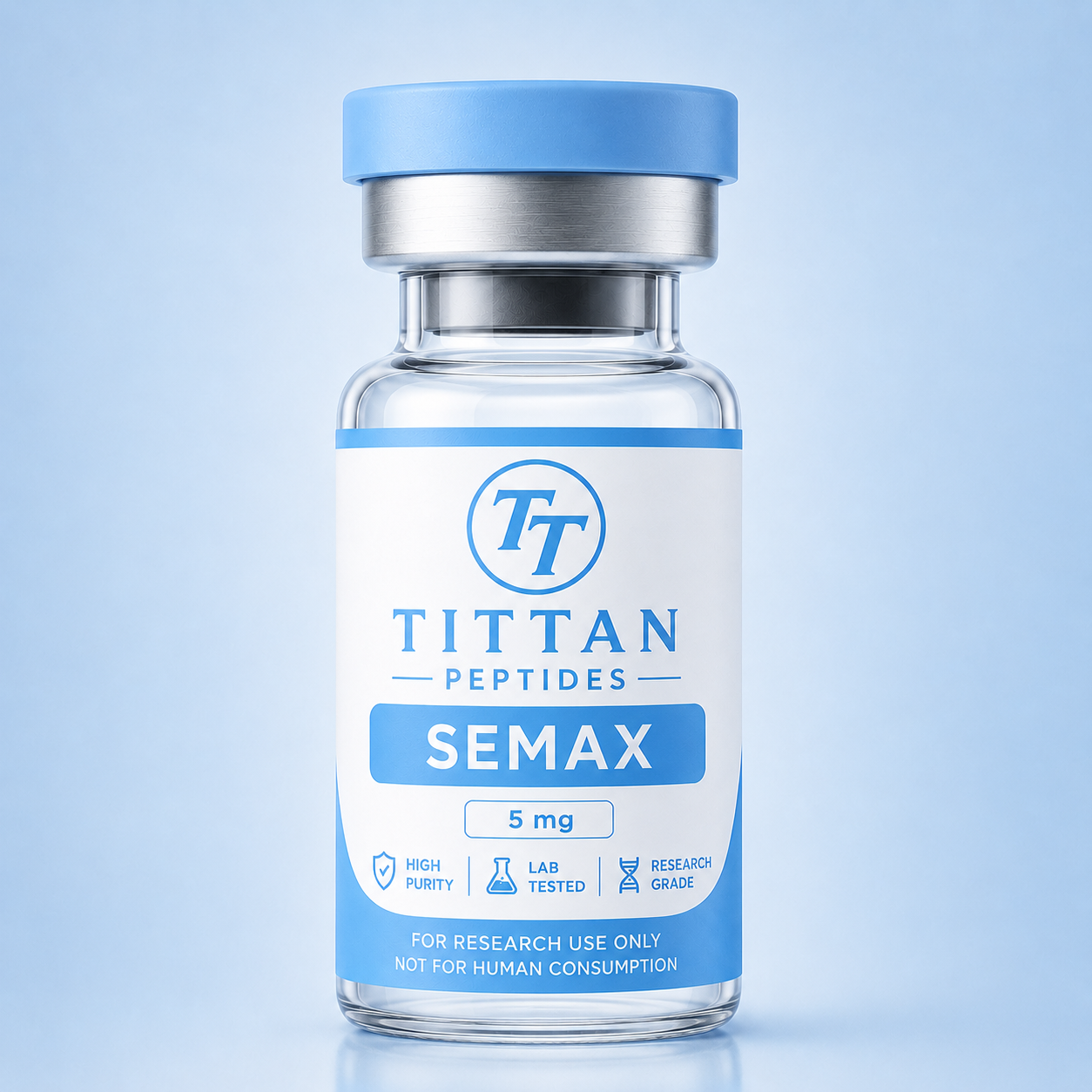
$29.00
Semax is a synthetic heptapeptide (Met-Glu-His-Phe-Pro-Gly-Pro) derived from the N-terminal fragment of adrenocorticotropic hormone (ACTH 4-10). Designed exclusively for laboratory research, this peptide exhibits neurotrophic, neuroprotective, and cognitive-enhancing properties without significant hormonal activity.
Unlike the parent ACTH molecule, Semax lacks corticosteroid-stimulating effects, making it a focused research tool for studying neuroplasticity, cerebral circulation, and neuronal repair mechanisms. Each lyophilized vial is synthesized to ≥98% purity, verified by independent HPLC and mass spectrometry. Researchers utilize Semax to investigate BDNF and NGF upregulation, antioxidant enzyme activity, and recovery following ischemic or hypoxic injury in preclinical models.
High Purity: ≥98% confirmed by third-party HPLC analysis
ACTH (4-10) Analogue: Retains neurotrophic effects without corticosteroid activity
Neuroprotective Properties: Reduces oxidative stress and excitotoxicity in research models
Stable Lyophilized Format: Easy reconstitution for cell culture or preclinical research
Research Use Only: Not for human consumption, clinical use, or therapeutic application
| Specification | Detail |
|---|---|
| Molecular Formula | C₃₇H₅₁N₉O₁₀ |
| Molecular Weight | 781.85 g/mol |
| Sequence | Met-Glu-His-Phe-Pro-Gly-Pro |
| Purity | ≥98% (HPLC) |
| Appearance | White lyophilized powder |
| Storage (Lyophilized) | -20°C, protected from light and moisture |
| Storage (Reconstituted) | 2-8°C for up to 7 days; aliquot for longer storage |
Semax is widely used in preclinical studies investigating:
Ischemic & Hypoxic Injury: Stroke models, cerebral ischemia, and oxygen-glucose deprivation (OGD)
Neuroprotection: Excitotoxicity, oxidative stress, and mitochondrial preservation
Cognitive Enhancement: Learning, memory consolidation, and attention in rodent models
Neurotrophic Factor Research: BDNF, NGF, and GDNF expression in hippocampal and cortical tissues
Retinal Neuroprotection: Glaucoma and optic nerve crush models
Parkinson’s Disease Models: Dopaminergic neuron preservation in MPTP-induced toxicity
| Parameter | Recommendation |
|---|---|
| Reconstitution | Sterile water or PBS (pH 7.0–7.4) |
| In Vitro Concentration | 0.1–100 µM (neuronal or microglial cultures) |
| Preclinical Dosage (Rodent) | 0.05–1 mg/kg, intranasal, intraperitoneal, or subcutaneous |
| Administration Frequency | Once daily or twice daily, depending on study design |
Note: These are references for laboratory protocol design only, not medical dosing instructions.
Semax exerts its research-documented effects through:
BDNF & NGF Upregulation: Increases mRNA and protein expression of neurotrophic factors in the hippocampus and cortex
Antioxidant Enzyme Activation: Enhances superoxide dismutase (SOD), catalase, and glutathione peroxidase activity
Cholinergic System Modulation: Increases acetylcholine levels and acetylcholinesterase regulation
Dopaminergic Protection: Reduces MPTP-induced dopaminergic neuron loss in Parkinson’s models
Cerebral Blood Flow Improvement: Modulates vascular tone and microcirculation in ischemic models
Anti-Inflammatory Effects: Reduces pro-inflammatory cytokines (IL-1β, IL-6, TNF-α) and NF-κB activation
| Feature | Semax | Selank | Noopept (Dipeptide) |
|---|---|---|---|
| Amino Acids | 7 | 7 | 2 (plus cyclization) |
| Origin | ACTH (4-10) fragment | Immunoglobulin G heavy chain | Racetam-like structure |
| Primary Mechanism | BDNF/NGF upregulation, antioxidant | Neurotrophins, cytokine modulation | AMPA receptor modulation |
| Primary Research Focus | Ischemia, neuroprotection, cognition | Anxiety, stress, and immune modulation | Neuroprotection, cognition |
| Hormonal Activity | None (ACTH-like activity removed) | None | None |
| Route of Administration (Preclinical) | IN, IP, SC | IN, IP, SC | Oral, IP |
This Semax product undergoes rigorous quality control, including:
HPLC Purity Verification: ≥98% with full chromatographic trace
Mass Spectrometry Confirmation: Molecular weight validated (ESI-MS)
Endotoxin Testing: <1 EU/mg for cell culture compatibility
Batch Tracking: Certificate of Analysis available for each lot
Reviews
There are no reviews yet.