- Your cart is empty
- Continue Shopping
Free Shipping for orders over $150
Welcome to Tittan Peptides!
Free Shipping for orders over $150
Welcome to Tittan Peptides!

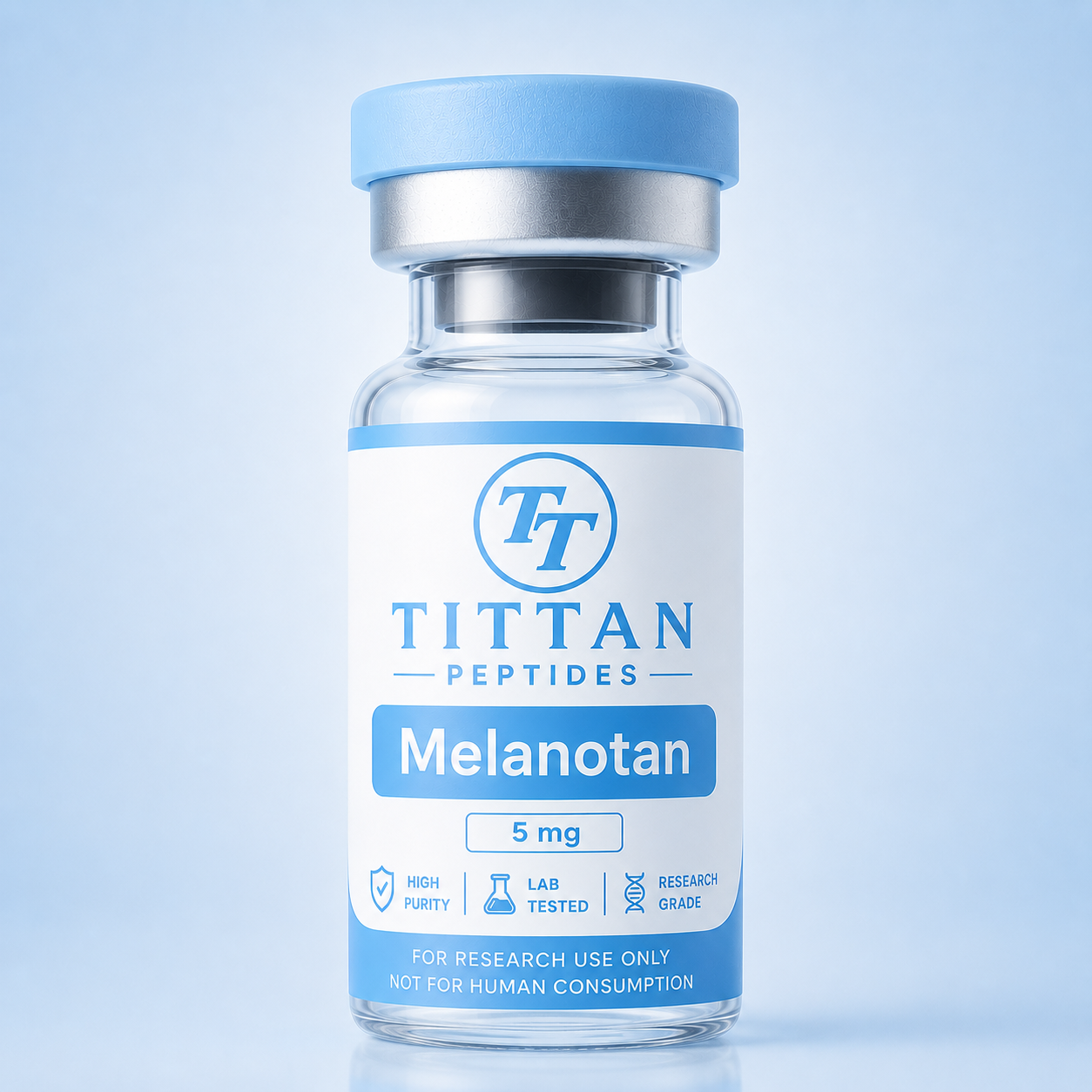
$42.00
PEPT-MT1-005
Melanotan 1 (MT-1), also known as afamelanotide, is a synthetic analogue of alpha-melanocyte-stimulating hormone (α-MSH) designed exclusively for laboratory research. This linear heptapeptide (Ac-Ser-Tyr-Ser-Nle-Glu-His-D-Phe-Arg-Trp-Gly-Lys-Pro-Val-NH2) acts as a potent, selective melanocortin-1 receptor (MC1R) agonist.
Used primarily in preclinical dermatological and photobiology research, Melanotan 1 stimulates eumelanin production without significant activation of other melanocortin receptors. This selectivity makes it a valuable tool for studying UV-independent melanogenesis, DNA repair pathways, and photoprotection mechanisms. Each lyophilized vial is synthesized to ≥99% purity, verified by independent HPLC and mass spectrometry.
Ultra-High Purity: ≥99% confirmed by third-party HPLC analysis
MC1R-Selective: Minimal cross-reactivity with MC3R, MC4R, or MC5R
UV-Independent Melanogenesis: Stimulates eumelanin production without UV exposure
Stable Lyophilized Format: Easy reconstitution for cell culture or preclinical research
Research Use Only: Not for human consumption, cosmetic use, or clinical application
| Specification | Detail |
|---|---|
| Molecular Formula | C₇₈H₁₁₁N₂₁O₁₉ |
| Molecular Weight | 1,646.85 g/mol |
| Sequence | Ac-Ser-Tyr-Ser-Nle-Glu-His-D-Phe-Arg-Trp-Gly-Lys-Pro-Val-NH₂ |
| Purity | ≥99% (HPLC) |
| Appearance | White lyophilized powder |
| Storage (Lyophilized) | -20°C, protected from light and moisture |
| Storage (Reconstituted) | 2-8°C for up to 14 days; aliquot for longer storage |
Melanotan 1 is widely used in preclinical studies investigating:
Photoprotection: Studying melanin-mediated UV radiation shielding and DNA damage repair
Erythropoietic Protoporphyria (EPP) Models: Light tolerance and oxidative stress reduction
Melanoma Research: MC1R signaling, pigmentation pathways, and tumor biology
Dermatological Inflammation: Contact hypersensitivity and sunburn cell formation models
| Parameter | Recommendation |
|---|---|
| Reconstitution | Sterile water or bacteriostatic water |
| In Vitro Concentration | 0.1–10 µM (melanocyte cultures) |
| Preclinical Dosage (Rodent) | 25–100 µg/kg, subcutaneous |
| Onset of Melanogenesis (In Vivo) | 7–14 days with daily administration |
Note: These are references for laboratory protocol design only, not medical dosing instructions.
Melanotan 1 exerts its research-documented effects through:
MC1R Activation: Stimulates adenylate cyclase → cAMP elevation → PKA activation
Eumelanin Upregulation: Increases tyrosinase, TRP-1, and TRP-2 expression
DNA Repair Enhancement: Promotes nucleotide excision repair (NER) pathways
Anti-Inflammatory Effects: Reduces UV-induced cytokine release (TNF-α, IL-6)
| Feature | Melanotan 1 (MT-1) | Melanotan 2 (MT-2) |
|---|---|---|
| Structure | Linear heptapeptide | Cyclic lactam |
| MC1R Selectivity | High | Moderate |
| MC3R/MC4R Activity | Minimal | Significant (appetite/libido effects) |
| Half-Life (Research Models) | ~1–2 hours | ~30+ minutes (longer in some models) |
| Primary Research Focus | Photoprotection, EPP | Pigmentation + appetite studies |
This Melanotan 1 product undergoes rigorous quality control, including:
HPLC Purity Verification: ≥99% with full chromatographic trace
Mass Spectrometry Confirmation: Molecular weight validated (ESI-MS)
Endotoxin Testing: <1 EU/mg for cell culture compatibility
Batch Tracking: Certificate of Analysis available for each lot
Shipping: Ambient with cold pack (2–8°C recommended during transit)
Upon Arrival: Store lyophilized material at -20°C immediately
Avoid Freeze-Thaw: Aliquot reconstituted peptide to prevent degradation
Shelf Life: 18 months from the manufacture date when stored as directed at -20°C

Reviews
There are no reviews yet.